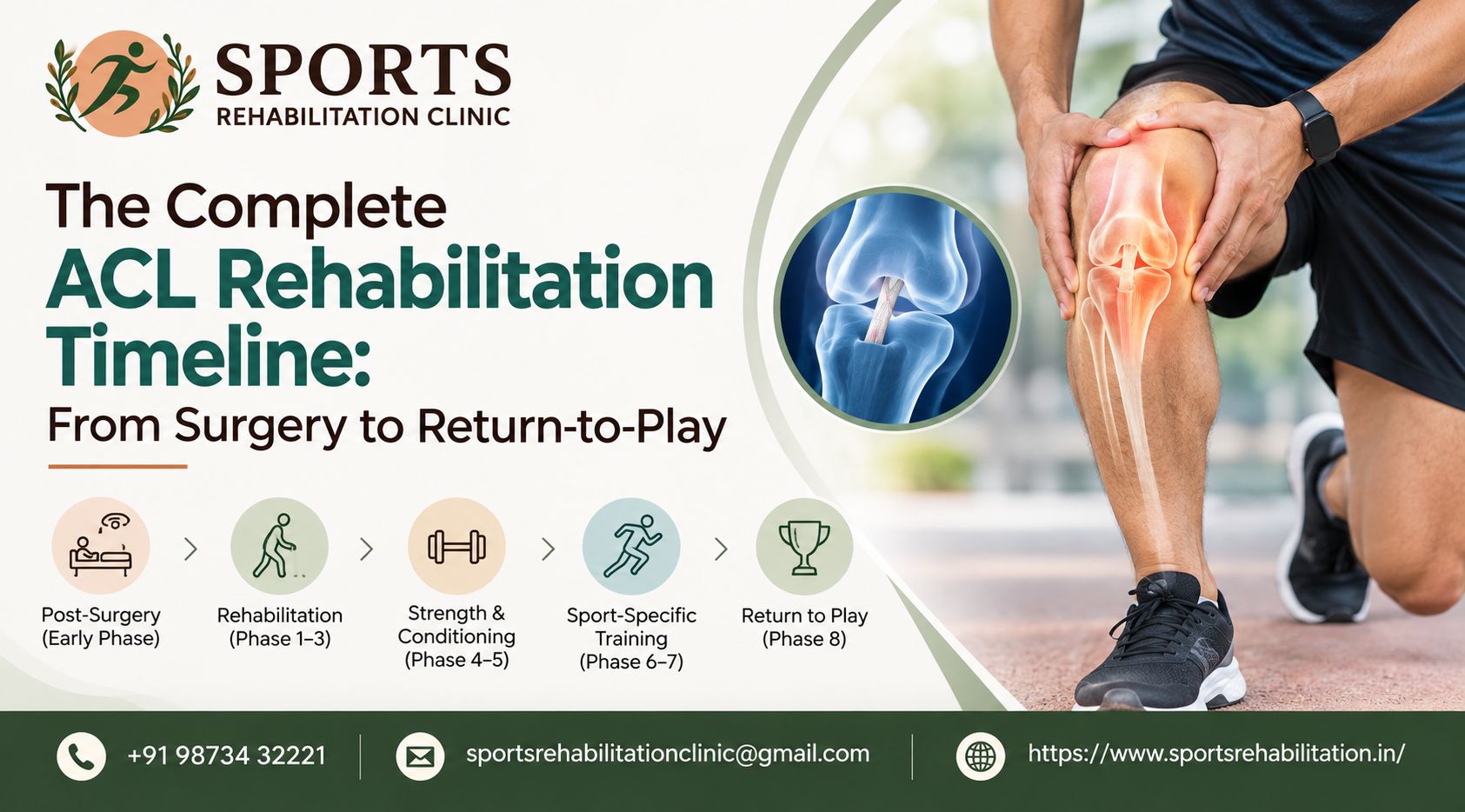
An ACL injury can be one of the most frustrating setbacks for an athlete. Whether it happens during football, cricket, basketball, badminton, running, or another sport, the road back to full performance requires much more than simply recovering from surgery.
ACL reconstruction is only the beginning. The real work starts during rehabilitation, where the goals are to reduce swelling, restore knee movement, rebuild strength, improve balance and coordination, and gradually prepare the athlete for the demands of their sport.
While every recovery is different, having a clear ACL rehabilitation timeline can help athletes understand what to expect at each stage.
Important: The timeline below is a general guide. Your rehabilitation plan may be different depending on the surgical technique, graft type, associated meniscus or cartilage injuries, age, strength, symptoms, and sport. Progression should be based on clinical milestones rather than time alone.
Phase 1: 0–2 Weeks — Protect the Knee and Control Swelling
The first two weeks after ACL surgery are primarily about healing and regaining basic knee function.
The main goals are to:
- Control pain and swelling
- Achieve full knee extension
- Gradually restore knee bending
- Activate the quadriceps
- Improve circulation
- Begin safe weight-bearing and walking as advised
Depending on the individual case, rehabilitation may include ankle pumps, quadriceps sets, heel slides and straight-leg raises.
At this stage, the quality of movement matters more than doing a large number of exercises. Excessive swelling or pain should not simply be ignored in an attempt to progress faster.
Phase 2: 2–6 Weeks — Restore Range of Motion and Basic Strength
As the knee settles, rehabilitation becomes progressively more active.
The focus is on achieving a more normal walking pattern and developing basic lower-limb strength. Exercises may include stationary cycling, bridges, controlled squats, step-ups and progressive resistance exercises.
Before moving forward, important milestones may include:
- Minimal or controlled swelling
- Near-normal range of motion
- Improved quadriceps activation
- Better walking mechanics
- Ability to perform basic exercises with good control
The exact progression can vary considerably, particularly when a meniscus repair or another procedure was performed alongside ACL reconstruction.
Phase 3: 6–12 Weeks — Build Strength and Single-Leg Control
This phase is where strength development becomes a major priority.
The quadriceps, hamstrings, glutes and calf muscles all need to regain adequate capacity. Exercises may progress to leg presses, split squats, lunges, hamstring strengthening and single-leg exercises.
However, simply becoming stronger is not enough. The athlete also needs to control the knee during single-leg movements.
A physiotherapist or sports rehabilitation specialist may assess how the knee behaves during squats, step-downs and other functional movements. At Dr. Akshay Sports Rehabilitation Clinic, for example, rehabilitation can be approached as a progressive process where exercise difficulty is adjusted according to the individual's movement quality and response to training.
Phase 4: 3–4 Months — Running Preparation
Running should not begin simply because an athlete has reached the three-month mark.
Before running, the knee should generally demonstrate appropriate range of motion, strength, control and symptom response. The athlete should also be able to perform functional exercises without significant pain or swelling.
Once appropriate criteria are met, running may be introduced gradually.
This phase can include:
- Walk-jog progressions
- Running technique
- Single-leg strength
- Hopping preparation
- Landing mechanics
- Balance and coordination drills
The goal is to teach the knee to tolerate progressively higher loads.
Phase 5: 4–6 Months — Agility, Jumping and Change of Direction
Once running is well tolerated, rehabilitation starts becoming increasingly sport-specific.
Athletes may progress to jumping, landing, acceleration, deceleration, lateral movements and changes of direction.
For example, a football or cricket player may need to develop the ability to accelerate and stop quickly, while a basketball or badminton player may require repeated jumping, landing and rapid directional changes.
This stage should progress gradually. Being able to run in a straight line does not automatically mean that an athlete is ready for cutting, pivoting or competitive sport.
Phase 6: 6–9+ Months — Return-to-Sport Preparation
The final phase is not simply about waiting for a particular month.
The athlete needs to demonstrate that the reconstructed knee and surrounding muscles can handle the physical and psychological demands of their sport.
Return-to-play assessment may include:
- Quadriceps and hamstring strength
- Single-leg strength and control
- Hop testing
- Jump and landing mechanics
- Agility and change-of-direction testing
- Acceleration and deceleration
- Sport-specific drills
- Training-load tolerance
- Psychological readiness
An athlete may feel physically better well before they are ready for unrestricted competition. Objective testing helps identify remaining weaknesses that may not be obvious during everyday activities.
Why Strength Symmetry Matters
One common mistake is assuming that normal walking and the absence of pain mean rehabilitation is complete.
An athlete can feel fine while still having significant weakness in the operated leg. This is particularly important for the quadriceps, which can lose strength quickly after ACL surgery.
The objective is not merely to make both legs look similar. The athlete needs sufficient absolute strength, power, control and movement quality for their particular sport.
Return-to-Play Is Not the End of Rehabilitation
Getting clearance to return to sport is an important milestone, but it should not be considered the finish line.
The athlete still needs to maintain strength, neuromuscular control, landing technique, agility and conditioning. Training loads should also increase progressively after returning to full practice and competition.
A well-designed injury-prevention program can become part of the athlete's regular training routine rather than something performed only during rehabilitation.
Can ACL Rehabilitation Be Faster?
Trying to speed up ACL recovery is understandable, particularly for competitive athletes. However, faster is not always better.
Progressing before the knee is ready can lead to setbacks, persistent swelling, strength deficits or poor movement patterns. At the same time, unnecessarily avoiding activity can also delay recovery.
The best approach is criteria-based progression: move forward when the athlete has achieved the appropriate physical and functional milestones.
When Should You Contact Your Healthcare Professional?
Some discomfort and swelling can occur during recovery, but worsening symptoms should not be ignored.
Seek medical advice if you experience significant or increasing swelling, severe or worsening pain, problems with the surgical wound, fever, unusual calf pain or swelling, or other symptoms that concern you.
Your surgeon and rehabilitation professional should guide decisions about exercise progression and return to sport.
The most successful approach is not to chase a particular date on the calendar. Instead, athletes should focus on achieving meaningful milestones at every stage and gradually exposing the knee to the demands it will face in sport.
With consistent rehabilitation, progressive strength training, appropriate testing and patience, the journey from ACL surgery back to the playing field can become a structured pathway toward confident performance—not simply a race to return.
Frequently Asked Questions
1. How long does ACL rehabilitation take?
There is no single recovery time for everyone. Many athletes require several months of structured rehabilitation before returning to unrestricted sport, and some require longer depending on their surgery, associated injuries, progress and sport.
2. When can I start running after ACL surgery?
Running is generally introduced when appropriate rehabilitation milestones have been achieved rather than at a fixed date. Adequate strength, movement control, range of motion and symptom management are important considerations.
3. Is 6 months enough to return to sport?
Not necessarily. Time alone does not determine readiness. Strength, hop performance, movement quality, sport-specific ability and psychological readiness should also be considered.
4. Can I return to sport without physiotherapy?
Structured rehabilitation is strongly recommended after ACL reconstruction. Attempting to return to demanding sport without appropriate rehabilitation can leave important strength and movement deficits unaddressed.
5. The Goal Is More Than Just a Recovered Knee
ACL rehabilitation is a journey that moves from healing to movement, from movement to strength, and from strength to athletic performance.